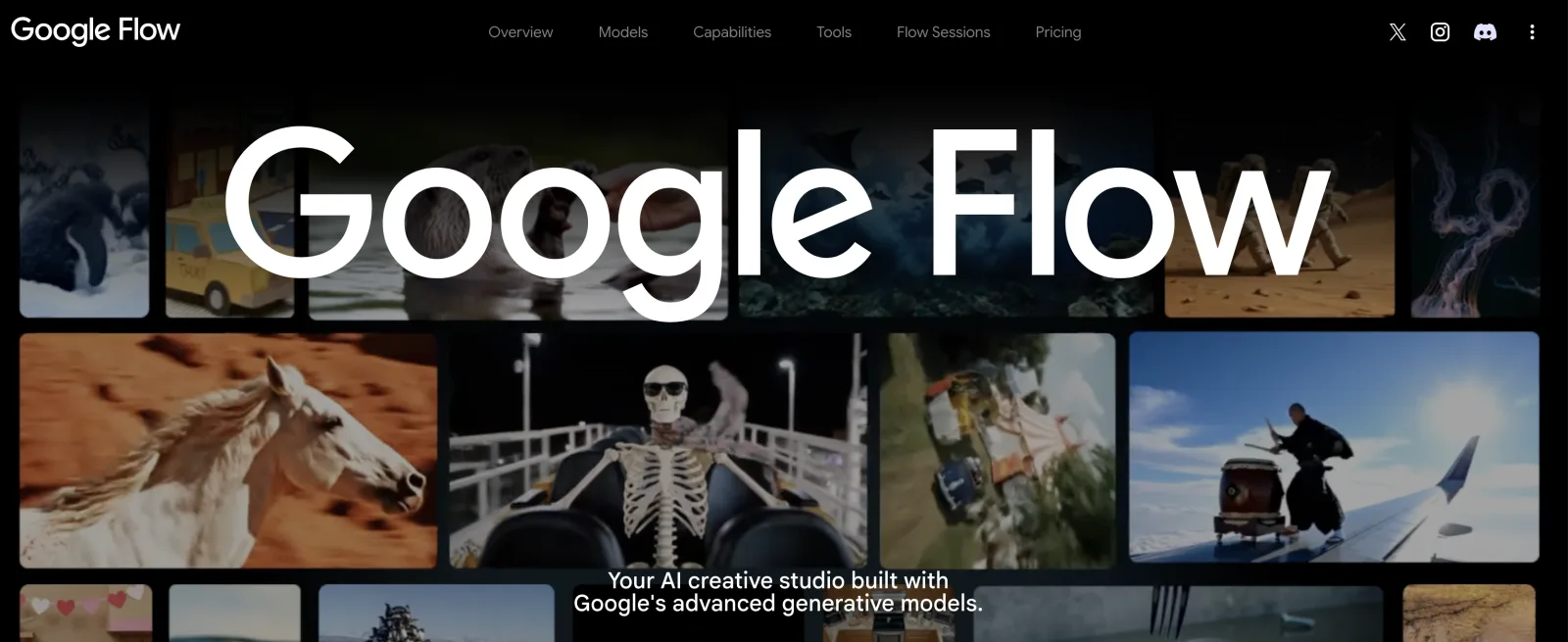
If you came here looking for Whisk, the short version is that it no longer exists on its own. Google shut it down on 30 April 2026 and moved what it did into Flow. Type the old address and you land on Flow with ?from=whisk stuck on the end of the URL, which is Google's way of telling you the redirect was deliberate.
This page covers what actually changed, what happened to anything you left behind, and where the old three-input workflow ended up.
What happened, and when
Google announced the move in March 2026 and gave roughly two months' notice. Whisk stopped working as a separate tool on 30 April.
The important detail, and the one that cost people work: anything still sitting in a Whisk library after that date was deleted permanently. Migration was opt-in. If you did not move your images across before the cutoff, they are not recoverable, and there is no support route that brings them back. Downloads had to happen before the deadline too.
Credits were the one thing that took care of itself. Whisk and Flow ran on the same credit system, so balances carried over with nothing to do.
One group got a worse deal than everyone else. Flow has not launched in every country, and users in unsupported regions lost Whisk without being offered anywhere to migrate to. If that is you, the tool is simply gone rather than relocated.
Where the three-input workflow went
Whisk's whole idea was that you handed it a subject, a scene and a style as pictures rather than describing them in a prompt. That idea survived, but it is no longer the centre of the product.
In Flow it appears as Ingredients — reference images you supply to hold a character or an object consistent across shots. The feature list calls it "Ingredients to Video." So the mechanic is intact, but it has been repointed at filmmaking rather than at making one still image.
If your reason for using Whisk was to produce a single picture by blending three references, that specific loop is clumsier now. It still works. It is just not what the interface is built around any more.
The models underneath changed too
This matters if you are following an older tutorial and wondering why your results look different.
Whisk generated images with Imagen 3, steered by Gemini. Flow does not use that stack. Image generation now runs on Nano Banana, the engine that used to be ImageFX, which Google merged into Flow in February 2026 along with Whisk itself. Video runs on Veo 3.1, and there is a Gemini Omni model handling edits from reference material.
So when a guide written in 2025 tells you Whisk is powered by Imagen 3, that was true when it was written and is not true now. Same for anything describing the Whisk interface screen by screen.
What Flow gives you that Whisk did not
Flow is a video tool that happens to make images, where Whisk was an image tool with no video at all. The named features are Text to Video, Frames to Video, Ingredients to Video, Video Extension, video-to-video editing, Scenebuilder, image upscaling, Characters and Avatars.
Scenebuilder is the piece with no Whisk equivalent. It is a timeline where you extend a shot or join clips together, keeping motion and characters continuous across the joins. Veo 3.1 also generates audio with the video — ambient sound, dialogue, music timed to lip movement.
What it costs
Whisk was free. Flow is free at the bottom and paid above that.
| Tier | Price | Credits |
|---|---|---|
| Free | $0 | 50 daily |
| Plus | $4.99/mo | 200 monthly |
| Pro | $19.99/mo | 1,000 monthly |
| Ultra | $99.99–$199.99/mo | 10,000–25,000 monthly |
Video costs considerably more credits per generation than images do, so a free allowance that felt generous under Whisk runs down faster in Flow if you are generating clips.
If you are arriving late
There is nothing to migrate any more — that window shut in April. What you can do:
Open Flow and check whether anything of yours came across, in case you migrated and forgot. Look under Ingredients for the reference-image workflow rather than hunting for the old Whisk screen. And if you are in a country where Flow has not launched, accept that this one is over rather than looking for a workaround.
About the older guides on this site
Most of what we have published here was written while Whisk was standalone, and it shows. Those pages describe an interface that no longer exists and a model that is no longer used. We are working through them rather than quietly deleting them, and every article written before the migration now carries a notice at the top saying so.
If a step in an old guide does not match what is on your screen, the guide is wrong, not you.
Sources: Google Workspace Updates, March 2026 and the Flow product page. Pricing and feature names checked 4 September 2026 — Google changes both regularly, so verify before relying on the figures above.